

X-Factor from Eternity
X Marks the Spot, Part Five

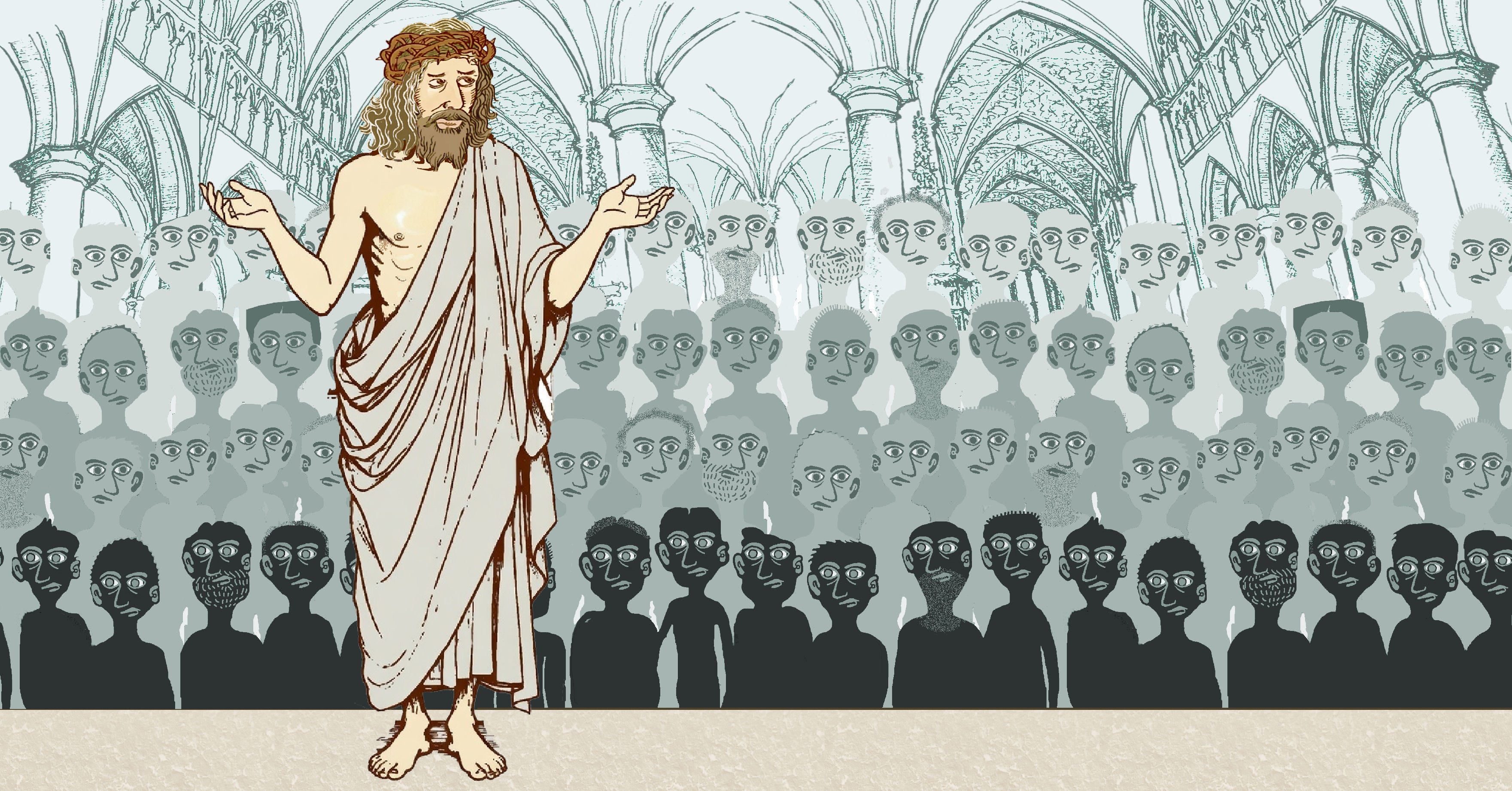
(Art by Michelle Horsley)
Reading from The Subversion of Christianity, by Jacques Ellul
(Audio version at the end)
Will to Powerlessness
“The renunciation of power is infinitely broader and harder than non-violence (which it includes). For non-violence allows of a social theory, and in general it has an objective. The same is not true of non-power. Thus the revelation of X cannot but repel fundamentally people of all ages and all cultures. . . . Freedom can never exert power” (Ellul, p. 166, 167).
The only freedom, one might even say, is in the will to powerlessness. Nietzsche could not have been more wrong.
Similarly, the only way to be without sin is never to cast the first stone—or any stone. To resist not evil, but the pull of mimetic violence that scapegoats supposed “evil,” and so finds safety in numbers, i.e., power. To renounce power and accept powerlessness is to become the scapegoat, i.e., to follow Christ.
Have confidence in his Word and not in a rational program. Enter on a way on which you will gradually find answers but with no guaranteed substance. . . . Grace is intolerable, the Father is unbearable, weaknesses discouraging, freedom is unlivable, spiritualization is deceptive. This is our judgment and humanly speaking it is well founded and inevitable. This is one of the first reasons for the rejection of the proclamation of God in Jesus Christ. . . . What we are summoned to do is something out of the ordinary. We are to be perfect as our Father in Heaven is perfect, no less. All else is perversion (p. 172, 173).
It is all or nothing, and so, of course, nothing is by far the easier option (as many a Dostoevsky character has argued). Yet a striving for nothing is also a reaction to the revelation of Christ, and may therefore be part of the will of God. The shadow tells us things about existence which the light cannot. (It tells us where to find the light)
Wherever there is an object (and an objective), there is its shadow. The Kingdom of Heaven is beyond all forms, and so Heaven is not, strictly speaking, something a formed creature can will for itself.
No form of action can be imitation of Christ, or of heavenly perfection. It is inaction that mirrors God. It is radical acceptance of reality beyond “good and evil,” i.e., beyond our insistence on judging the difference, or even understanding how there can be one.
Dostoevsky’s nihilistic characters were realer, more profoundly worked out, more multifaceted, and more moving to me, generally speaking, than his overtly devout ones. Prince Myshkin is the exception, and Myshkin’s flaws were prodigious (making him more in line with Biblical protagonists, who seem to be chosen despite themselves).
Salvation is of the Damned
The declaration that we are justified by grace, by the sovereign love of God manifested in the death of Jesus, dispossesses us of something that we regard as essential, namely, that we should fashion our own righteousness. . . . Indeed, we have to admit that there is no place for human dignity in the Bible. The one condition for coming to the Eucharist is the admission that we are not worthy. Nietzsche was right. He expressed the natural, the normal thinking of natural and normal people. He was not a demonic destroyer of Christianity. He was not a philosophical genius. He was simply a natural human being, taking seriously what the Bible says and as energetically as possible rejecting it as unacceptable. . . . . We do not want grace. Fundamentally, what we want is self-justification. There thus commences the patient work of reinterpreting revelation so as to make of it a Christianity that will glorify humanity and in which humanity will be able to take credit for its own righteousness (p. 160, 161).
Nietzsche admired Dostoevsky (we can only guess what Dostoevsky might have made of Nietzsche), and no wonder: he was a kind of Dostoevsky character himself (part Stavrogin, part Kirilov, part Raskolnikov, mostly Ivan Karamazov). I think Ellul is correct in viewing Nietzsche’s rage against the Bible as somehow both more honest and more human—even, in a contradictory sense, more devout—as a reaction to the Bible that most Christians never dare allow themselves.
Certainly I relate, and so, I would like to think so. My brother destroyed himself in a similar revolt against God, and the notion that he could be eternally damned for it is as unacceptable to me as the idea that God is the evil fabrication of devilish religious engineers, for increasing their power and control over humanity.
Actually, the two ideas are complementary, to the point of being two sides of the same error, for me at least. (It is all-too easy to see how sensible people would reject all beliefs about God that include such a viciously incoherent principle as eternal damnation.)
I reject both ideas with the same force, and for the same reason, and my own resistance to the Bible does indeed border on disgust, some of the time at least, and at least when presented as an infallible book of rules to be followed—or else! My disgust has to do, not so much with the text itself (though sometimes that too), as with all the people who have asserted its meanings and values, for personal reasons, without being able to understand them or to live them (nobody can). In a word, hypocrites.
From my own point of view (in accord with Nietzsche, and with Dostoyevsky at his best/worst), no one can say they are Christian without being a hypocrite. Not unless it be with the understanding that it is impossible to be a Christian, unless Christianity is seen as a flawed, mostly futile (or at best counterproductive) means to some other, mysterious end, an end that is essentially not of this world, that never has been and never will be.
Something unfathomable entered into history: this is all we know for sure. That, and that it left some scratchings on the wall of time that have been ever after mistranslated, misinterpreted, and misrepresented, and that therefore are next to (but not quite) useless in terms of understanding whatever it was, much less how to find and follow it.
But the residue of memory, of meaning, is that, whatever it was, that X-factor from eternity is now known to us, in some form, as having access to history, i.e., to our own lives. And so it can be found at any time, and followed to its source. We have only to let it know that we are here.
